I should be upfront with you before this article starts properly.
I haven’t attended a major B2B trade show or conference recently.
That gap actually makes this article more useful, not less. Because the tactics I’m going to share aren’t things I read in a roundup last week. They’re things I watched work — and watched fail — across multiple events, multiple industries, multiple countries. The lessons have had time to settle.
And the honest observation from that distance: most of what companies do at events is expensive, passive, and forgettable. The few things that actually generated leads and relationships were almost always low-cost, human, and slightly unexpected.
That’s what this is about.
First: the uncomfortable math of events
Let’s acknowledge what we’re working with.
Trade shows and in-person events have the highest average cost per lead of any B2B marketing channel — around $811 per lead when you factor in booth costs, travel, logistics, and staff time. (Source: SeoProfy citing VisitorQueue) A mid-size exhibitor typically spends $10,000–$30,000 per show.
That number gives most marketing teams pause. And it should.
But here’s the counterpoint: 81% of event attendees have buying authority and 92% are actively looking for new products or suppliers at the time of attending. (Source: Wave Connect) And 65% of B2B buyers say attending an event influenced their purchase decision. These are not passive browsing leads. These are people who showed up specifically because they have a problem to solve.
The issue isn’t that events don’t work. It’s that most companies waste the opportunity entirely — spending a fortune on the booth and then behaving in ways that guarantee forgettability.
So the zero-budget-growth approach to events isn’t “don’t go.” It’s: go, but allocate almost nothing to passive presence and everything to active tactics that cost only time.
Before the event
Own the search before anyone arrives
Before any event I was involved with, the first thing I’d do was write a piece of content optimised for the event name. Not a press release — an actual useful article. “What to expect at [Event Name] 2026: the sessions worth your time, the themes to watch, and what we’ll be showcasing.”
People Google events before they attend. They look for agendas, exhibitor lists, and honest previews. If your article shows up when they search “[Event Name] exhibitor worth visiting” — you’ve already made contact before a single handshake.
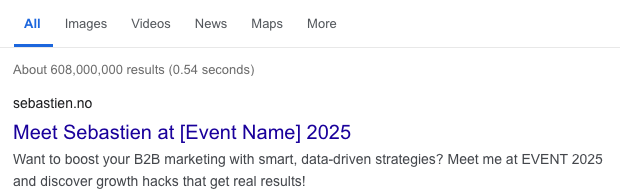
At Piql, we did a version of this before a major facilities management trade show. The article ranked, it was linked from the event’s own preview content, and three people explicitly mentioned they’d found us that way when they visited the booth. Three warm leads from a blog post. Cost: a few hours of writing.
The tactic in 2026: same logic, now expanded. Write the article, post a LinkedIn thread, record a 90-second “what we’re bringing to [Event Name]” video on your phone. Event hashtags matter more than ever — 89% of event planners now use mobile event apps to engage attendees, and those apps surface content with the event hashtag. (Source: WiFi Talents) Be in those conversations before doors open.
Find attendees before the event and reach out first
This one I learned the hard way — by not doing it early enough and watching a competitor show up to conversations I should have already been in.
Every major B2B event has an attendee list, a LinkedIn event page, or at minimum a hashtag that early registrants use. Start monitoring that two to three weeks before the event. Find the people you actually want to talk to. Connect on LinkedIn with a message that’s genuinely human — not a pitch, just: “I see you’re going to [Event]. I’ll be there too — would love to connect if our schedules align.”
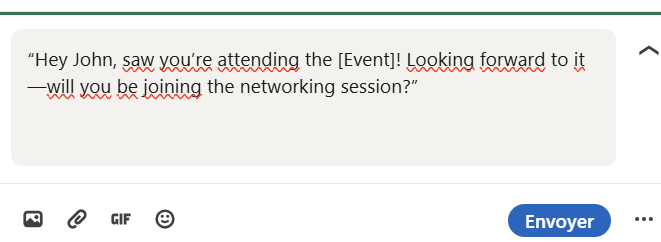
By the time you meet in person, you’re not a stranger. You’re someone they recognize. That changes the entire conversation.
I’ve done this manually (tedious but effective) and with tools like PhantomBuster for LinkedIn event scraping (faster, same principle). The cost is the same either way: time. The return is a pre-warmed relationship list that turns cold booth interactions into warm continuations.
Send something before you arrive
Before one conference, I coordinated sending a short personalised email to a list of confirmed attendees we’d identified — not marketing copy, just a note saying we’d be at booth X and here’s the one specific thing we’d be showing that was relevant to them.
Response rate was significantly higher than any cold outreach we did post-event. Why? Because they hadn’t met you yet. There’s no awkwardness of “I already told you I wasn’t interested” — just a low-stakes heads-up from someone who clearly did their homework.
During the event
Move. Don’t wait.
This is the single biggest mistake I saw — repeatedly, across every company I worked with. The team sets up the booth, stands behind it, and waits.
Nobody interesting is found by waiting.

The most useful thing I ever did at a B2B event was leave the booth. Walk the floor. Attend two or three sessions. Go to the networking lunch. Talk to other exhibitors — not as prospects, but as peers. Some of the best referral relationships I’ve built came from conversations with non-competing companies at the same event.
The booth is where people come to you. The floor is where you find the people who will never walk past your stand.
Assign someone to stay at the booth. Then get out.
Record short videos — on your phone, during the event
Not a polished brand video. Not something that needs editing. Just: walk up to someone you’ve had a good conversation with and ask if they’d share one quick thought for your LinkedIn audience. Thirty seconds. Their insight, their name, their company.
This works for three reasons:
- People love exposure. Most B2B professionals are happy to be featured if you make it easy and low-stakes.
- It gives you real content to post during and after the event — content that performs better than any polished video because it feels human.
- It deepens the connection. Asking someone to share their perspective is a compliment. It’s different from asking for their card.

I’ve seen this turn into weeks of LinkedIn content from a single two-day event. Four or five short clips, each posted separately with a line of context, each tagging the person featured. Each one extending the event’s reach beyond the room.
Kill the paper business card
In every event I attended past 2022, business cards disappeared into jacket pockets and were never seen again. I know this because I was the one retrieving those pockets’ contents at the end of the day and trying to remember who each card belonged to.
A QR code linking directly to a contact form — or to a LinkedIn profile, or to a short landing page with one clear action — works infinitely better. The scan happens in the moment, the connection is made while the conversation is fresh, and you don’t need to decipher handwriting later.
Free options: QR code generators are everywhere. A Google Form or a simple Linktree page works. The frictionless capture is the point.
Own the event hashtag conversations
Most companies post once before the event and then go quiet. The gap between what they post and what actually gets engagement is enormous — and entirely exploitable.
During the event: post from the sessions. Share a takeaway from the keynote before the session ends. Ask a question to the LinkedIn audience about a topic that came up in a panel. Quote something interesting someone said (with their permission). Tag the event, tag the speakers, use the hashtag.
The content that performs best at events is live, specific, and conversational — not corporate. Your phone, posted in real time, beats anything a comms team schedules from headquarters.
Use a small game or a tangible hook at the booth
I’ll admit I was sceptical of gamification at events until I saw it work twice in quick succession.
At one trade show, a neighbouring exhibitor ran a simple “spin to win” with genuinely useful prizes — not branded pens, but things people actually wanted: an Amazon voucher, a free annual subscription, a consulting hour. The queue for their booth was visible from fifty metres away.

The learning: the game itself isn’t the point. The game is permission to stop someone, start a conversation, and capture contact details in a natural way. The entry requirement — “scan this QR code with your email” — does the lead capture. The prize gives people a reason to do it without feeling like they’re being sold to.
Cost: the prize (which can be modest) and a free QR form. Everything else is setup time.
After the event
This is where most companies completely lose the leads they spent thousands of dollars to collect. And it’s the part that costs nothing to get right.
Score and triage within 24 hours
Not all leads are the same. Some people scanned your QR code because they wanted to win something. Others spent twenty minutes at your booth and asked specific technical questions. The second group needs to hear from you within 24 hours, while they still remember the conversation.
After every event I worked on, the first thing I’d do on the train or plane home was go through every contact collected that day and write one line of context next to each one. What did we talk about? What was their specific problem? What did I promise to send them?
That note, written in the moment, is worth more than any lead enrichment tool you’ll use three weeks later when the memory has faded.
Then triage: three categories — hot (follow up today or tomorrow), warm (follow up this week), cold (add to newsletter, no individual outreach needed). That structure makes the follow-up feel manageable rather than overwhelming.
Send a personal follow-up — not a template
51% of attendees request a follow-up visit from a sales representative after an event — but most companies respond with a generic “great to meet you” email that could have been sent to anyone. (Source: Cvent citing CEIR)
The follow-up that actually works references the specific conversation. It’s short. It has one clear next step. It sounds like a human wrote it, because a human did.
If you promised to send something — an article, a case study, a specific piece of information — send it with the follow-up. Never promise something at an event and then not include it in the first message. That’s the fastest way to confirm you weren’t listening.
A short personalised video recorded on your phone — sixty seconds, using their name, referencing what you discussed — converts dramatically better than any email. It’s different enough to get opened. It’s human enough to generate a response. And it costs nothing but two minutes of time per person.
Repurpose everything
The content you captured during the event doesn’t expire when the event does.

The video clips become individual LinkedIn posts over the next two weeks. The notes from sessions become a “three things I learned at [Event Name]” article. The conversations you had become the basis of a more detailed piece on whatever topic came up most frequently. The lead magnet you promoted at the booth continues running on your website.
52% of marketers attribute at least half of their company’s closed-won deals to events — but that attribution only holds if you keep the momentum going after doors close. (Source: Vendelux citing HockeyStack 2025) The event is not the end of the funnel. It’s the beginning.
Turn the best conversations into something lasting
The most underused follow-up tactic I’ve seen: asking one or two people from the event to collaborate on something.
A joint LinkedIn post sharing perspectives on a topic you both care about. A short co-authored piece. An invitation to appear in your next podcast episode or newsletter interview. Something that gives them value, gets you exposure to their audience, and keeps the relationship active past the initial follow-up.

This is the kind of thing that turns an event contact into a genuine professional relationship. Which is, ultimately, what events are actually for.
I said this at the top and I want to come back to it honestly.
The B2B event landscape in 2026 has changed since my last active event circuit. AI-powered matchmaking is now used by 52% of event professionals to connect attendees before they even arrive. (Source: WiFi Talents) Mobile event apps are near-universal. QR-based lead capture is now standard rather than novel. The pre-event LinkedIn outreach tactic I described as slightly unusual a few years ago is now common enough that people have developed filters for it.
Which means the bar for standing out has risen. The tactics above still work — but they work better when executed with more care, more personalisation, and more genuine curiosity than everyone else bothers with.
What hasn’t changed: 80% of attendees still prefer in-person events over virtual equivalents, and the conversion quality from event leads remains among the highest of any channel. (Source: Wave Connect) The room is still where the relationships happen. The free tactics above are still the ones that generate them.
I’ll be back at events when the circumstances allow. When I am, these are exactly what I’ll be doing.
I write about B2B growth and what actually works without a budget — every two weeks at sebastien.no. Find me on LinkedIn.
Comments