
Years ago, I worked for a small e-commerce website selling brewing equipment. Kettles, hops, pipes — all the stuff for people who dream of making their own beer at home.
One Friday afternoon, the boss leaned over my desk: “Can we push something for the weekend? Like, now?”

No designer. No brief. No budget. I threw together a landing page — one blurry product image, big red text, a yellow button. It looked like a 2006 scam email. I cringed posting it.
It worked. Better than anything we’d launched that month.
That moment stuck with me. And after 14 years of running growth on shoestring budgets — across startups, scale-ups, and large companies where the marketing budget exists on paper then gets cut in Q3 — I finally understand why it worked.
| Before getting into lo-fi specifically, here’s the context. This blog is built around one central idea: Zero Budget Growth. Not a cute synonym for “growth hacking.” A real philosophy — built from years of being the person who had to create traction, leads and revenue with almost nothing. The reality is that only 24% of CMOs felt they had sufficient budget to execute their strategy in 2025. Three-quarters of marketing leaders operate under constraint, all the time. That’s not a temporary problem. That’s the job. What I’ve learned is that constraints don’t limit growth — they force better thinking. Lo-fi growth is what happens when you stop trying to out-spend and start trying to out-connect. |
What is Lo-fi Growth
Lo-fi (low fidelity) is a term from music: rough recordings, intentional imperfections, warm and human rather than polished and sterile. In marketing, same idea.
Lo-fi growth is fast, unpolished, and human-feeling content — not because you’re lazy, but because those qualities tend to outperform their opposites in most modern channels.
In practice: a selfie video recorded in your car, a text-only LinkedIn post, a Notion page turned into a free resource, an email that reads like a message from a friend.
None of it would win a Cannes Lions award. All of it can outperform the thing that would.
Why it works
People trust what feels human
We’ve all developed finely-tuned radar for corporate polish. Perfectly lit product shots, sentences approved by seven people in Legal, stock photos of diverse teams smiling at laptops — we scroll past all of it on autopilot.
More than 60% of consumers say authentic and relatable content is more important than polished, high-quality content. UGC-based ads — the formalized version of lo-fi — achieve up to 4x higher click-through rates than traditional branded content.
And as AI-generated content floods every channel, that human signal is becoming more valuable by the day. 63% of marketers now recognize they need human-centered, unique content to cut through — precisely because AI saturation has made differentiation harder for everyone playing it safe.
Speed is a competitive advantage
Here’s something most marketing teams don’t want to admit: the approval process kills more growth than lack of budget.
I’ve seen companies spend three weeks on a campaign video that was already irrelevant by the time it launched. Meanwhile, a competitor’s scrappy LinkedIn post gets 40,000 impressions on the same topic — posted the day the news broke.
Lo-fi is fast. No brief, no agency, no sign-off chain. Idea → make the thing → post. Sometimes in an afternoon. That means you can test five messages in a week, learn what resonates, and double down before spending serious money on the wrong direction.
Platforms reward it
This isn’t a workaround. It’s how the algorithms are built.
TikTok, LinkedIn, Instagram Reels, YouTube Shorts — these platforms reward content that feels native, not like an ad. Lo-fi, unpolished content drives 1.8–2x more comments than campaign-quality posts on TikTok. TikTok’s average engagement rate hit 4.20% in 2025 — while Instagram’s polished brand content averaged just 0.48%. That’s not a small gap.
Real examples
The MS Paint job ad
The City of Los Angeles once posted a job ad for a graphic designer that looked like it was made by a caffeinated 8-year-old. Comic Sans. Clashing rainbow letters. Cube drawings in MS Paint.
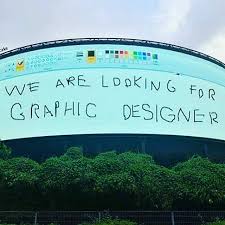
It went viral. 30,000 retweets and thousands of replies. Designers everywhere felt personally called out — and applied.
The brilliance was accidental in execution but perfect in logic: the ad communicated something true about the situation. It was unexpected, self-aware, and memorable in a way no polished job listing could be.
The Tennessee Titans lo-fi video that beat the celebrities
For their 2023 schedule release, the Titans produced two videos. One: high production, featuring comedian Nate Bargatze, Jelly Roll, and Keith Urban. The other: a crew member with a phone, asking random people on Broadway to identify the Titans’ opponents by their logo.
The lo-fi one went viral. It won a Nashville Emmy Award for best social/interactive video. They did it again in 2024 and got 4.6 million views — second most of any NFL team.
Watch the 2023 version here:
The celebrity version barely made a dent. The janky street interview became a franchise.
The “we failed” LinkedIn post that booked 100 demos
A B2B marketer wrote a long post about a campaign that flopped. No image. Just a story: “We tried something. It didn’t work. Here’s what we learned.” And at the very end: “If you’re facing the same issue, happy to show what we’re testing now — DM me.”
100+ demos that week. No ad spend. No design. Just honesty, said clearly, to an audience dealing with the exact same problem..
When to go lo-fi (and when not to)
Lo-fi is not always the answer. There are moments where production value signals credibility and earns its cost — enterprise sales decks, mainstream PR, brand partnerships where aesthetics are a proxy for “are these people serious.”
Here’s the rough guide I use:
Go lo-fi when:
- You’re testing a new message or offer before investing in it
- Speed matters more than polish
- You’re on social platforms where native content wins
- You’re selling something personal — coaching, services, handmade products
- Your audience already knows and trusts you
Consider hi-fi when:
- You’re in a final-stage enterprise sales process
- You’ve already validated the message and need to scale it
- The audience is evaluating you partly on aesthetics
The mistake most teams make is defaulting to hi-fi for everything because it feels safer. But that default is expensive, slow, and often wrong.
The compounding argument
Here’s the number that changed how I think about this:
The bootstrapped ones tested with content first. They knew what worked before they paid for anything.
Content marketing generates 3x more leads than outbound and costs 62% less. And it compounds: a LinkedIn post from six months ago can still surface in search. A blog post from last year can rank on page one today. Paid advertising stops the moment the budget runs out. Lo-fi content keeps working.
A practical starter kit
Pick one of these this week. Do it in under an hour.
- The honest LinkedIn post — write about something that didn’t work and what you learned. No image, no hashtags. Under 300 words.
- The free Notion resource — list 15–20 things your audience would find useful. Share it in two communities.
- The founder video — 90 seconds, one take (max two), selfie mode. Post it on LinkedIn. No fancy caption.
- The ugly landing page test — headline, three bullets, one button. Run it for a week before you build the polished version.
- The plain-text email — starts with “Just shipped something.” No images. Under 200 words.
None of these require a designer, a budget, or a sign-off from anyone.
In a world drowning in AI-generated perfection, the scarcest thing in marketing is humanity. Lo-fi growth isn’t about being cheap or lazy. It’s about being real — and choosing real over polished when real will serve your audience better.
After 14 years of making marketing work with limited resources, I keep landing on the same conclusion: the constraints were never the problem. The thinking was.
Done and real beats perfect and late. Every time.
Comments