
In 2008, I did my first internship at an SEO agency.
I was 21. I was enthusiastic. I had no idea what I was doing — but honestly, neither did most of the industry. Google was six years old. Panda and Penguin didn’t exist yet. The entire game was: get links, stuff keywords, repeat. The more of it you did, the more it worked.
The agency I worked at was a small operation. A handful of people running a very efficient “black-hat” production line. My job, alongside a rotating roster of other interns, was to churn it out: directory submissions to dubious link farms, keyword density checks (we had a target percentage — I’m not proud), footer link insertions across client sites, article spinning, hidden text in page backgrounds the same colour as the font. The kind of techniques every modern SEO professional now lists under “what NOT to do” and every certification course covers as cautionary tales.
It worked, at the time. Rankings moved. Clients were happy. The agency billed them monthly.

Then Google launched Panda in 2011 — targeting thin, low-quality content — and Penguin in 2012 — targeting link manipulation and web spam. Overnight, the techniques we’d been running didn’t just stop working. They started actively destroying the rankings we’d built. Some of those client sites got deindexed entirely.
What happened to those clients?
Most of them had no idea. They’d trusted the agency to handle it. They never understood what was being done in their name.
That experience — almost 20 years ago now, which is a genuinely horrifying number — is why I want to write an honest article about when not to hire an SEO agency. Not because agencies are all bad. But because too many small businesses and startups hire them for the wrong reasons, at the wrong moment, without the right questions.
The agency I hired (and what happened)
Fast forward many years.

I’d worked in-house long enough to understand the fundamentals, but I was stretched thin across multiple responsibilities and thought bringing in an agency would accelerate things. The initial pitch was good: clear process, content strategy, monthly reporting, measurable targets. They knew the right words.
What actually happened was more familiar than I’d like to admit.
The first month: an audit. A thorough audit, professionally formatted, that largely confirmed things I already knew. The second month: keyword research and “content planning.” Also useful, also largely confirmatory. By month three, content started appearing on the site. Generic, technically correct, obviously templated. The kind of article that answers a keyword query without ever saying anything a competitor couldn’t also say.
The reporting was excellent. Beautifully formatted PDFs showing impressions trending upward, “rankings improved” (without always specifying for which queries), and traffic numbers that looked good in isolation but didn’t connect clearly to any business outcome.
After six months: some rankings had moved. Organic sessions were up modestly. Leads from organic: essentially unchanged.
Honest post-mortem: the agency was competent. They weren’t running black-hat techniques. They were doing the standard playbook — audit, keywords, content, links — with adequate execution. The problem was that adequate execution of a standard playbook, in a market where every competitor is running the same playbook, is not going to move the needle for a small team trying to break through.
What would have moved the needle: someone with genuine expertise in our specific niche, with the autonomy to make content decisions quickly and the understanding of our buyer to write from experience rather than keyword intent.
That person doesn’t exist at a generalist agency. They exist on your team or as a dedicated freelance specialist.
The uncomfortable truth about the SEO agency market in 2026
Let me give you the numbers first.
The average SEO agency retainer for a small business in 2026 is $1,500–$5,000 per month. (Source: ALM Corp) That’s $18,000–$60,000 per year. US-based agencies average $98.90/hour, freelancers $71.59/hour, according to the 2026 Ahrefs survey of 439 SEO professionals (Source: OuterBox citing Ahrefs) and 70% of agencies increased their pricing in 2025 due to inflation and AI-driven industry changes.
For that money, you get: a mix of technical auditing, keyword research, content production, and link building — executed at scale, usually across many clients simultaneously, by account managers who are likely covering 15–25 accounts at any given time.
The fundamental tension: good SEO in 2026 is specific, experience-based, and deeply connected to your buyer’s actual journey. Agency delivery is generalist, templated, and optimised for operational efficiency across a client portfolio.
That’s not an accusation. It’s a business model constraint. And it means agencies can be excellent value — at the right scale, for the right problem. But for a lot of small businesses, they’re the wrong solution entirely.
When NOT to hire an SEO agency
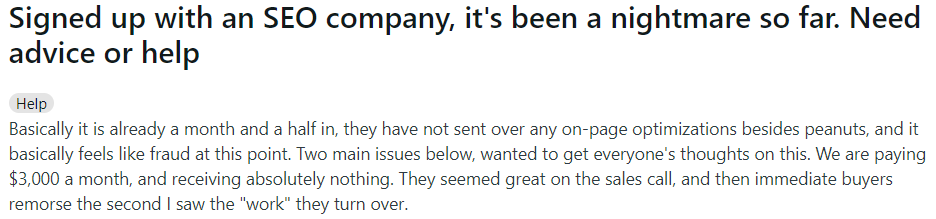
Here are the specific situations where an agency retainer will likely disappoint you.
When you don’t have a content strategy yet
An SEO agency cannot substitute for a content strategy. They can produce content — but content without a clear editorial direction, a defined audience, and a point of view is just keyword-targeted filler. If you haven’t yet answered “who are we writing for, what problems do we solve, and what perspective do we bring?”, an agency will fill that gap with generalist answers. Those answers will produce generalist content. Generalist content doesn’t rank well anymore, and in 2026 it certainly won’t get cited in AI-generated responses.
Build your content strategy first. Then bring an agency in to execute against it.
When your site has fundamental technical problems you don’t understand
This sounds counterintuitive — isn’t fixing technical problems what agencies do? Yes. But if you don’t understand the technical problems yourself, you have no way to evaluate whether the fix was done correctly or whether the “audit” you paid €2,000 for identified the real issues or the easy-to-report ones.
Before hiring an agency: run Google Search Console yourself (free), run a Screaming Frog crawl (free up to 500 URLs), read the output. Even a surface-level understanding of your own site’s technical state lets you ask better questions and spot bullshit answers.
When your budget is under €1,000/month
Below a certain spend, you are not a priority client at any legitimate agency. You’re being managed by a junior account executive running a standardised checklist. The partner who pitched you has moved on to larger accounts.
At that budget, your money goes further with a freelance specialist who is genuinely invested in your outcome because it’s their reputation and their livelihood. Or it goes into learning and doing it yourself — which, for most small B2B teams, is more valuable long-term than outsourcing something you don’t understand.
When you’re expecting quick results
Good SEO takes 6–12 months to show material results in competitive niches. Any agency that suggests otherwise is either targeting very low-competition queries (where you didn’t need an agency) or making promises they can’t keep.
If you need leads in the next 90 days, SEO — agency-led or otherwise — is not your answer. Paid search, cold outreach, and partnerships move faster. SEO is a compounding long-term channel. Fund it accordingly or don’t fund it at all.
When you’re in a rapidly shifting niche
This one is 2026-specific. If your business is in AI, emerging tech, GEO optimization, creator economy, or any space where the landscape is shifting faster than a quarterly content plan can adapt — a traditional agency will be producing content about yesterday’s world. The 3-month editorial plan they build in month one will be partially obsolete by month three.
Fast-moving niches need someone who is in the conversation daily, not someone managing your account between a portfolio of other clients. That person is you, a specialist freelancer, or a subject matter expert on your team.
What the SEO landscape actually needs in 2026 (and what agencies weren’t built for)
Here’s the broader context.
The SEO agency model was built for a world where SEO was primarily about technical compliance and content volume. Do the audit, fix the tags, produce the articles, build the links. Execute that playbook well and rankings followed.
That world is gone. Not entirely — the technical fundamentals still matter. But the new game is more complex:
- GEO optimization — getting cited in AI-generated responses from ChatGPT, Claude, Gemini, Perplexity — requires content that is specific, sourced, and experience-based. Templated agency content does not get cited. AI systems summarise it without attribution and move on.
- AI Overviews on Google are absorbing the click-through traffic that used to reward ranking positions. Ahrefs found AI Overviews reduce position-one CTR by 58%. (Source: Jasper Blog citing Ahrefs) An agency optimising for traditional rankings is optimising for a shrinking prize.
- E-E-A-T (Experience, Expertise, Authoritativeness, Trustworthiness) — Google’s quality framework — specifically rewards first-hand experience. Agency writers who have never worked in your industry cannot demonstrate first-hand experience about it. Your team can.
The skills that matter most for visibility in 2026 — personal perspective, cited sourcing, genuine topical authority, presence in the communities your buyers trust — are not skills an agency can deploy on your behalf. They can only come from inside your organisation.
What to do instead
This isn’t an argument for doing nothing. It’s an argument for doing the right things yourself before you outsource.
- Build your own content foundation first. Write 10–15 articles from genuine experience in your domain. Not keyword-targeted at first — just honest, specific, useful pieces on the problems you actually solve. This establishes a baseline that any agency you eventually hire can build on. Without it, they’re building on sand.
- Learn the technical basics yourself. Google Search Console, basic on-page SEO, understanding how crawling and indexing works. This takes two weekends. It doesn’t make you an SEO expert, but it makes you an informed buyer — which dramatically improves your outcomes if you do eventually hire.
- Hire a freelance specialist instead of a generalist agency. A freelancer with genuine experience in your niche, who handles 5–10 clients rather than 25, who you can call on the phone without going through an account manager, and whose income depends on actually delivering results. The 2026 Ahrefs data shows freelancers average $71.59/hour versus $98.90/hour for agencies. (Source: OuterBox) You pay less per hour and get someone who’s more accountable for outcomes.
- Invest in GEO alongside SEO. If you’re spending on content, make sure it’s structured for AI citation — not just traditional ranking. Specific, sourced, first-person sections of 120–180 words. Named data points. Quotable sentences. These cost nothing extra to build into your content and significantly increase your visibility in AI-generated responses.
- Use agency-level tools at free tier. Google Search Console, Ahrefs Webmaster Tools (free for your own domain), and Screaming Frog’s free tier cover most of what you need for technical and keyword work at a small-site scale.
When agencies ARE worth it
To be fair: there are situations where an SEO agency genuinely earns its retainer.
At scale — when you have 500+ pages and the technical complexity is real, when you’re targeting multiple markets in multiple languages, when the link building required is beyond what an in-house team can manage — agency infrastructure makes sense.
For specific one-time projects — a technical audit of a large site, a structured data implementation, a site migration — where you need execution expertise for a bounded piece of work, a project-based agency engagement can be excellent value.
When you have a clear strategy and need execution — after you’ve done the foundational work, defined your content direction, and built enough understanding to brief well and evaluate outputs — an agency can scale what you’ve proven. But you need to have proven something first.
The mistake is hiring an agency at step one and expecting them to do all of that thinking for you. They can’t. And the ones who say they can are, more often than not, running a version of the same playbook I was part of in 2008.
The names of the techniques have changed. The dynamic hasn’t.
I write about B2B growth, zero-budget marketing, and things I’ve learned the hard way — every two weeks at sebastien.no. Find me on LinkedIn.
Comments